Learning how to read Tarot cards can feel overwhelming at first. A traditional Tarot deck contains 78 cards, each filled with symbols, archetypes, numbers, colors, and possible interpretations. Add reversed cards, spreads, card combinations, and intuition, and it can seem as though you need to memorize an entire language before you can give your first reading.
You don’t.
The easiest way to learn Tarot is to begin with a simple question, a small number of cards, and a repeatable reading process. Instead of trying to memorize every possible meaning, learn how the structure of the deck works, understand the core message of each card, and practice connecting that message to the question in front of you.
This beginner’s guide will show you exactly how to read Tarot cards step by step, from choosing a deck and asking better questions to interpreting individual cards and combining them into a meaningful reading.
Quick Answer: How Do You Read Tarot Cards?
To read Tarot cards as a beginner:
- Choose a Tarot deck you can understand easily.
- Familiarize yourself with the 78-card structure.
- Decide what you want guidance about.
- Ask an open-ended question.
- Shuffle the cards while focusing on that question.
- Draw one card or use a simple Tarot spread.
- Observe the card before checking its traditional meaning.
- Connect the card’s meaning with its position and your question.
- Look for relationships between multiple cards.
- Write down your interpretation and reflect on it later.
You do not need psychic abilities or perfect knowledge of all 78 cards to start reading Tarot. What matters most is having a consistent method and practicing regularly.
If you’re completely new to Tarot, explore our Learn Tarot section as you work through this guide.
What Is Tarot?
Tarot is a deck-based system commonly used for reflection, storytelling, spiritual exploration, and divination.
A standard Tarot deck contains 78 cards, divided into two main groups:
The Major Arcana — 22 cards
These cards represent significant archetypes, themes, transitions, and life experiences.
Examples include:
- The Fool
- The Magician
- The High Priestess
- The Lovers
- Death
- The Tower
- The Star
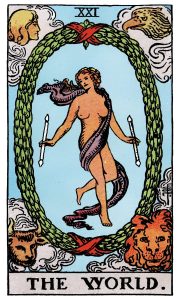
- The World
The Minor Arcana — 56 cards
These cards tend to describe everyday experiences, emotions, relationships, thoughts, conflicts, opportunities, and practical circumstances.
The Minor Arcana contains four suits:
- Wands
- Cups
- Swords
- Pentacles
Understanding this structure makes learning Tarot considerably easier because you begin recognizing patterns rather than memorizing 78 unrelated definitions.
Step 1: Choose a Beginner-Friendly Tarot Deck
Your first Tarot deck does not need to be expensive, rare, or spiritually significant.
It simply needs to be readable.
For most beginners, a deck based on the Rider-Waite-Smith tradition is particularly useful because its illustrated scenes provide visual clues that can help you understand a card without immediately opening a guidebook.
When choosing your first deck, look for:
- clear imagery
- recognizable symbols
- illustrated Minor Arcana cards
- artwork that emotionally resonates with you
- a useful guidebook
A visually complex deck may be beautiful, but it can make learning harder if you cannot easily understand what is happening in each image.
Do You Need to Be Gifted Your First Tarot Deck?
No.
A popular Tarot tradition says that your first deck should be given to you by someone else, but you do not need to follow this tradition in order to read Tarot.
You can purchase your own deck and begin learning immediately.
Choose a deck that makes you curious enough to keep picking it up.
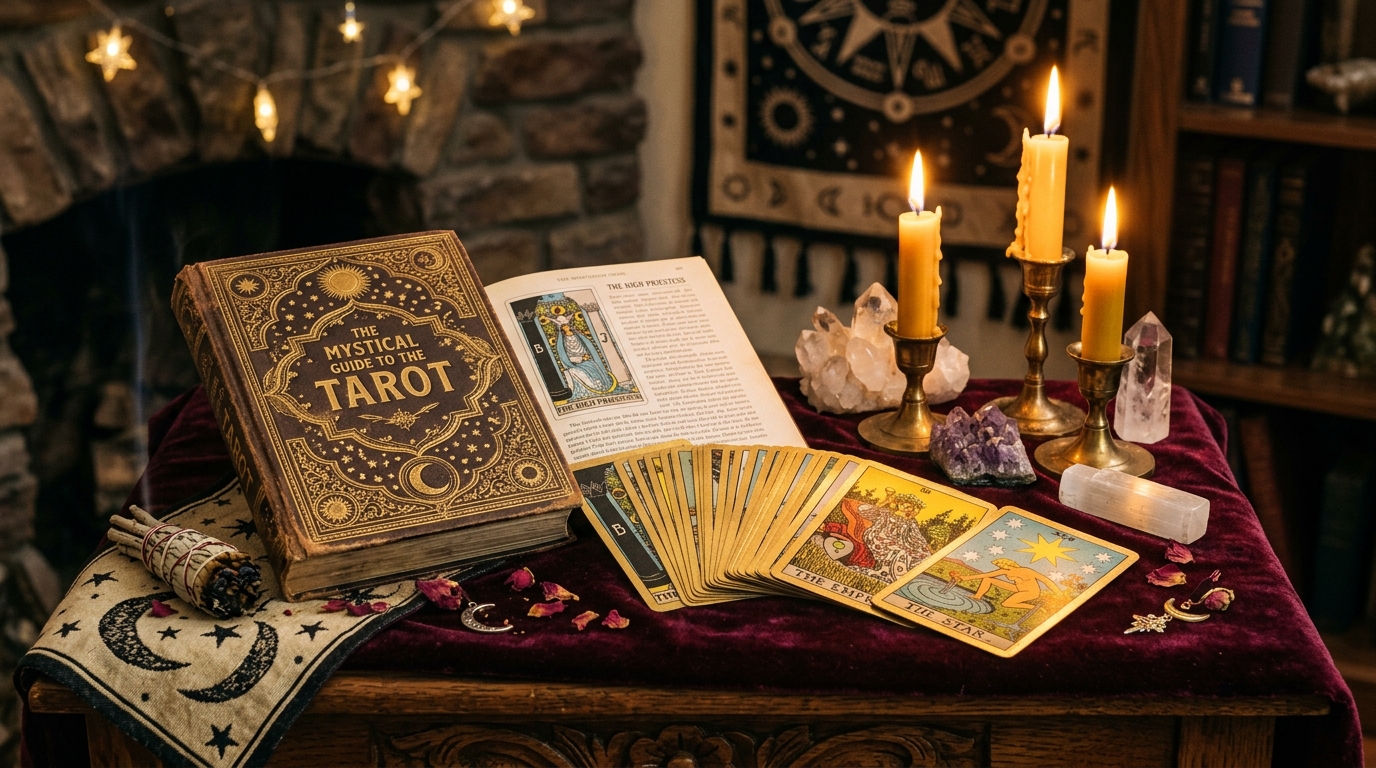
Step 2: Understand the Structure of a Tarot Deck
Before memorizing individual cards, learn the architecture of the deck.
Think of Tarot as a language.
The Major Arcana represents major themes.
The Minor Arcana describes how those themes may appear in ordinary life.
The four suits add another layer of meaning.
Wands
Wands are commonly associated with:
- action
- creativity
- ambition
- passion
- motivation
- personal energy
A reading dominated by Wands may point toward movement, initiative, work, inspiration, or the desire to make something happen.
Cups
Cups are commonly connected with:
- emotions
- relationships
- love
- intuition
- connection
- emotional fulfillment
Several Cups in a reading may suggest that emotional or relationship matters are especially important.
Swords
Swords commonly relate to:
- thoughts
- communication
- decisions
- conflict
- truth
- mental pressure
A Sword-heavy reading may indicate that the situation is strongly influenced by thinking, communication, choices, or tension.
Pentacles
Pentacles are commonly associated with:
- money
- work
- health and the physical world
- resources
- stability
- material concerns
Several Pentacles may draw attention toward practical circumstances, finances, career, security, or long-term development.
A Simple Shortcut for Beginners
When you see a card, first ask:
Is this Major Arcana or Minor Arcana?
If it is Minor Arcana, ask:
Which suit is it?
Those two observations already give you useful information before you remember the card’s individual meaning.
Step 3: Learn Tarot Through Patterns, Not Pure Memorization
One of the biggest mistakes beginners make is attempting to memorize 78 definitions before doing any readings.
Instead, learn Tarot in layers.
For each card, begin with:
Image → feeling → traditional meaning → context.
Imagine you draw The Hermit.
Before reaching for the guidebook, look at the image.
Ask yourself:
- What is happening?
- Is the figure alone or surrounded by people?
- Does the scene feel peaceful or lonely?
- Where is the figure looking?
- What symbols stand out?
- What emotion does the image create?
You might notice solitude, contemplation, distance, or searching.
Those observations already bring you close to common interpretations of The Hermit: introspection, inner guidance, withdrawal, reflection, and searching for wisdom.
Then compare your observations with the traditional meaning.
Over time, this process helps the cards become recognizable rather than memorized vocabulary.
Step 4: Create a Calm Reading Space
You do not need candles, crystals, incense, or a special altar to read Tarot.
Use them if they help you focus, but they are optional.
What matters is having enough mental space to pay attention.
Before a reading, you might:
- silence notifications
- sit somewhere comfortable
- take a few slow breaths
- place your question in front of you
- spend a moment looking through your deck
A Tarot reading does not need to become an elaborate ritual.
For a beginner, consistency is usually more valuable than complexity.
Step 5: Ask a Good Tarot Question
The quality of your question strongly influences the usefulness of your reading.
Beginners often start with questions such as:
“Will I get the job?”
That can be difficult because it encourages you to reduce a complex situation to a simple yes or no.
Try:
“What should I understand about my current job opportunity?”
Or:
“What can I focus on to improve my approach to this opportunity?”
Instead of:
“Will my relationship last?”
Consider:
“What should I understand about the current dynamic in this relationship?”
Open-ended questions give the cards more room to describe patterns, influences, possibilities, and actions.
Useful Tarot Question Starters
Try:
- What should I understand about…?
- What am I overlooking about…?
- What energy surrounds…?
- What can I learn from…?
- What should I focus on regarding…?
- What may help me move forward with…?
- What is influencing this situation?
Treat Tarot as a tool for exploration rather than a substitute for your own judgment.
For serious medical, legal, financial, or safety decisions, appropriate professional advice should take priority over a Tarot reading.
Step 6: Shuffle Your Tarot Cards
There is no single correct way to shuffle Tarot cards.
You can:
- shuffle them like ordinary playing cards
- spread them across a table and mix them
- divide the deck into several piles
- shuffle until you intuitively feel ready to stop
Choose whatever method feels comfortable and does not damage your cards.
While shuffling, keep your question in mind.
You do not need perfect concentration. The purpose is simply to bring your attention back to the subject of the reading.
What If a Card Falls Out While Shuffling?
Some readers interpret cards that fall or “jump” from the deck.
Others simply return them and continue shuffling.
Either approach is fine.
The important thing is consistency. Decide how you will handle jumping cards before you start interpreting them.
Step 7: Start With a One-Card Tarot Reading
A one-card reading is one of the best ways to learn Tarot.
It forces you to spend time with a single card instead of becoming overwhelmed by multiple meanings.
Try asking:
“What should I pay attention to today?”
Shuffle the deck and draw one card.
Then use this five-part process.
1. Observe
What immediately catches your attention?
2. Describe
What is literally happening in the image?
3. Feel
What emotional atmosphere does the card create?
4. Interpret
What are the card’s traditional themes?
5. Connect
How could those themes relate to your question?
That final step is crucial.
A Tarot card does not exist separately from the question.
Step 8: Try a Simple Three-Card Tarot Spread
Once you feel comfortable reading one card, move to three.
Three cards provide enough information to create a story without overwhelming a beginner.
A classic spread is:
Card 1: Past
Card 2: Present
Card 3: Future
But there are many alternatives.
For example:
Situation — Challenge — Advice
or:
Mind — Body — Spirit
or:
What I know — What I don’t see — What to consider
For beginners, Situation — Challenge — Advice is especially useful because each position has a clear purpose.
Suppose you ask:
“What should I understand about starting a new project?”
You draw:
Ace of Wands — Eight of Swords — The Magician
You could begin by interpreting each card separately.
The Ace of Wands may suggest inspiration or a new spark.
The Eight of Swords may suggest feeling restricted, uncertain, or mentally trapped.
The Magician may point toward using available skills, resources, and initiative.
Now connect them.
One possible reading could be:
There appears to be genuine enthusiasm around beginning the project, but self-doubt or perceived limitations may be creating hesitation. The final card shifts attention toward what is already available: skills, tools, and the ability to take deliberate action.
Notice that the cards become more useful when they are read as a sequence rather than as three isolated definitions.
Step 9: Read the Card in Context
Tarot meanings change depending on the question and spread position.
Suppose you draw The Hermit.
In a relationship reading, it might suggest:
- needing personal space
- introspection
- emotional distance
- understanding yourself before making a relationship decision
In a career reading, the same card could point toward:
- independent work
- research
- reassessing career direction
- learning from an experienced guide
In a position labeled “Advice,” The Hermit may encourage reflection before acting.
The card is the same.
The context changes how its symbolism applies.
This is why memorizing a single sentence for every Tarot card is rarely enough.
Step 10: Learn to Read Tarot Card Combinations
When two or more cards appear together, don’t interpret them as completely separate messages.
Ask how they interact.
For two cards, try this formula:
Card A + Card B = combined message
For example:
The Fool + The Chariot
The Fool can represent beginnings, openness, or stepping into the unknown.
The Chariot can represent direction, determination, and forward movement.
Together, they might suggest beginning something new and then committing yourself to a clear direction.
Now consider:
The Fool + Four of Cups
The Fool still introduces the possibility of a new beginning, but the Four of Cups may add hesitation, emotional disengagement, or failure to notice an opportunity.
The meaning changes because the cards modify one another.
This is one of the most important skills to develop once you understand individual cards.
For deeper practice, visit our Tarot Card Combinations guide.
Step 11: Should Beginners Read Reversed Tarot Cards?
You may notice that some readers interpret cards differently when they appear upside down.
These are called Tarot reversals.
A reversed card does not automatically mean something bad.
Depending on the reader and context, a reversal might indicate:
- blocked energy
- internalized energy
- delay
- imbalance
- resistance
- a weakened or intensified expression of the upright card
However, beginners do not need to use reversals immediately.
You can read all cards upright while learning their core symbolism.
Once you understand the deck comfortably, experiment with reversals if they add useful nuance to your readings.
Learning Tarot is not a race to use every technique at once.
Step 12: Use Intuition Without Ignoring Traditional Meanings
Tarot reading often involves a balance between traditional symbolism and personal interpretation.
Imagine drawing the Six of Cups.
Traditional interpretations often connect it with nostalgia, memories, childhood, generosity, or the past.
But perhaps the first thing you notice is one small visual detail that reminds you of an old friendship.
Should you ignore that association because it isn’t written in your guidebook?
Not necessarily.
Instead, combine both sources of information.
Ask:
Does my intuitive reaction make sense in the context of the card and the question?
Intuition works best when it expands interpretation rather than replacing every established meaning.
A useful beginner formula is:
Traditional meaning + visual observation + question context + intuitive response = interpretation
Step 13: Look for Patterns Across the Reading
After interpreting individual cards, zoom out.
Ask what patterns appear.
Major Arcana
Several Major Arcana cards may indicate that the reading involves significant themes, turning points, or lessons.
Repeated Suits
Many Cups may emphasize emotions or relationships.
Many Pentacles may emphasize practical or material concerns.
Many Swords may highlight thoughts, communication, decisions, or conflict.
Many Wands may emphasize action, creativity, motivation, or ambition.
Repeated Numbers
Repeated numbers can provide another layer of pattern recognition.
For example, several Aces may draw attention toward beginnings or potential.
Several Tens may suggest completion, culmination, or transition.
Court Cards
Multiple Pages, Knights, Queens, or Kings may highlight personality traits, roles, approaches, or—in some reading traditions—people involved in the situation.
Direction and Imagery
Look at the figures on the cards.
Are they facing each other?
Turning away?
Looking toward another card?
Does one card appear visually connected to the next?
These visual relationships can help you turn individual cards into a coherent story.
Step 14: Keep a Tarot Journal
A Tarot journal is one of the simplest ways to improve.
For each reading, write down:
- date
- question
- spread
- cards drawn
- your first impression
- traditional meanings
- your interpretation
- what happened afterward, when relevant
The last step is especially valuable.
Looking back at old readings helps you identify which interpretations were useful and where you may have misunderstood a card.
You also begin developing your own relationship with the deck.
For example, a particular card may repeatedly appear when you experience a specific type of situation.
That personal pattern can become part of your reading vocabulary.
A Beginner Tarot Reading Example
Let’s walk through a complete example.
Question
“What should I understand about changing careers?”
Spread
Situation — Challenge — Advice
Cards
Eight of Cups — Two of Swords — Page of Pentacles
Card 1: Eight of Cups — Situation
The Eight of Cups is often associated with leaving something behind in search of something more meaningful.
In the context of a career question, it could reflect emotional dissatisfaction with the current path or a growing desire to explore another direction.
Card 2: Two of Swords — Challenge
The Two of Swords often points toward indecision, avoidance, or difficulty choosing between alternatives.
As the challenge card, it may suggest that uncertainty—not necessarily lack of opportunity—is making movement difficult.
Card 3: Page of Pentacles — Advice
The Page of Pentacles is commonly associated with learning, practical beginnings, study, and developing a new skill.
As advice, it could encourage a practical first step: researching the new field, taking a course, improving a skill, or testing the new direction before making a larger commitment.
Reading the Three Cards Together
Instead of saying:
“Eight of Cups means leaving. Two of Swords means indecision. Page of Pentacles means studying.”
Turn them into one message:
You may already feel that your current path is no longer fulfilling, but uncertainty about what comes next could be preventing action. Rather than forcing an immediate all-or-nothing decision, consider approaching the transition as a learning process and taking a practical first step toward the new direction.
That is the difference between knowing Tarot card meanings and reading Tarot.
Common Tarot Reading Mistakes Beginners Make
1. Drawing Too Many Clarifying Cards
You draw a card you don’t understand.
So you draw another.
Then another.
Soon you have nine cards answering a one-card question.
More cards do not always create more clarity.
Before drawing a clarifier, spend more time with the original card.
Ask:
What exactly don’t I understand about this card?
Only then decide whether another card would genuinely help.
2. Asking the Same Question Repeatedly
Repeatedly drawing cards until you receive an answer you prefer makes interpretation less useful.
If the reading is unclear, write it down and return to it later.
3. Treating Every Card as a Prediction
Tarot can be used predictively within some traditions, but a reading can also explore:
- current patterns
- emotional dynamics
- choices
- obstacles
- possible directions
- questions worth considering
You do not need to treat every card as a fixed event waiting to happen.
4. Panicking When You Draw a Difficult Card
Cards such as Death, The Tower, The Devil, or Ten of Swords can look frightening.
Avoid jumping immediately to the most dramatic interpretation.
For example, Death often symbolizes endings, transition, release, or transformation rather than literal physical death.
Always interpret the card within the question and surrounding cards.
5. Depending on the Guidebook Forever
Guidebooks are useful.
Use them.
But before opening one, spend 20–30 seconds studying the image and forming your own impression.
This small habit trains you to actually read the cards instead of simply looking up definitions.
6. Trying to Memorize Everything Before Practicing
Practice is part of learning.
You do not graduate from studying Tarot and then begin reading.
Reading Tarot is how you learn Tarot.
How to Practice Tarot Every Day
You don’t need to perform a complicated spread every morning.
Try a simple daily-card practice.
Ask:
“What energy should I be aware of today?”
Draw one card.
Write three things:
1. What I notice: Describe the image.
2. What the card traditionally means: Write two or three keywords.
3. How it might relate to today: Write one or two sentences.
At the end of the day, return to your journal.
Ask:
How did this card show up in my day, if at all?
This creates a feedback loop between symbolism and lived experience.
After several weeks, you may find that card meanings become much easier to remember.
How Long Does It Take to Learn Tarot?
There is no fixed timeline.
You can learn enough about the basic structure of Tarot to begin practicing in a single day.
Becoming comfortable interpreting cards together takes longer.
Developing a nuanced personal reading style can take months or years of practice.
You do not need to wait until you “know Tarot” before giving yourself simple readings.
Start with one card.
Then three.
Build gradually.
Do You Need Psychic Abilities to Read Tarot?
No special psychic ability is required to learn the mechanics of Tarot reading.
Tarot can be approached in different ways.
Some people view it primarily as a spiritual or divinatory practice.
Others use Tarot as a reflective framework for examining situations, ideas, emotions, and possibilities.
Some combine both approaches.
You can decide which relationship with Tarot makes sense for you.
Can You Read Tarot for Yourself?
Yes.
Reading Tarot for yourself is one of the easiest ways to practice regularly.
The challenge is objectivity.
When you strongly want a particular outcome, it is easy to interpret ambiguous cards in a way that supports what you already hope or fear.
To reduce this tendency:
- write your question before drawing cards
- choose the spread in advance
- record your first interpretation
- avoid repeatedly redrawing cards
- revisit the reading later
Writing creates distance between the reading and your immediate emotional reaction.
How Many Tarot Cards Should a Beginner Draw?
Start with one to three cards.
One card helps you learn individual symbolism.
Three cards teach you how cards interact.
Larger spreads can be useful later, but more cards create more relationships to interpret.
For a beginner:
1 card = learning meaning
2 cards = learning interaction
3 cards = learning narrative
Master those skills before worrying about elaborate spreads.
A Simple Tarot Reading Method You Can Use Every Time
When you don’t know what to do next, remember:
O — Observe
What do you literally see?
M — Meaning
What does the card traditionally represent?
P — Position
What does this position in the spread ask the card to describe?
Q — Question
How does the card relate to the original question?
C — Connect
How does it interact with the surrounding cards?
This turns Tarot reading into a repeatable process.
For example:
Card: The Star
Position: Advice
Question: “How should I approach this difficult period?”
You might begin with:
Observe: A calm figure, water, stars, openness.
Meaning: Hope, renewal, healing, faith, inspiration.
Position: This card is offering advice.
Question: The reading concerns navigating difficulty.
Connect: If surrounding cards suggest exhaustion or disruption, The Star may emphasize restoration and maintaining hope while rebuilding.
You are no longer trying to remember a perfect sentence.
You are constructing meaning.
Beginner Tarot Cheat Sheet
Here is a simple framework to remember:
| Tarot Element | Think About |
|---|---|
| Major Arcana | Major themes, lessons, transitions |
| Wands | Action, passion, creativity, ambition |
| Cups | Emotions, relationships, intuition |
| Swords | Thoughts, communication, conflict, decisions |
| Pentacles | Work, money, resources, practical life |
| Aces | Beginnings, potential |
| Pages | Learning, curiosity, messages |
| Knights | Movement, pursuit, action |
| Queens | Internal mastery, expression, maturity |
| Kings | Direction, authority, mastery |
Treat this as a learning framework rather than a rigid dictionary. The card image, question, spread position, surrounding cards, and reading tradition can all change the nuance.
Frequently Asked Questions About Reading Tarot
What is the easiest way to learn Tarot cards?
Start with one card per day instead of trying to memorize all 78 cards. Observe the imagery, learn the card’s core traditional meaning, connect it to a simple question, and record your interpretation in a Tarot journal.
What Tarot spread should a beginner use?
A one-card reading is the easiest starting point. Once comfortable, try a three-card spread such as Situation — Challenge — Advice.
Do I need to memorize all 78 Tarot cards?
No. Learn the deck’s structure first, then gradually learn individual cards through repeated readings. Understanding suits, numbers, imagery, and Major versus Minor Arcana reduces the amount of pure memorization required.
Can I read Tarot without knowing every card meaning?
Yes. Use visual observations, the card’s basic meaning, the question, and its spread position. Checking a guidebook during a reading is completely reasonable while learning.
Should beginners use reversed Tarot cards?
Not necessarily. Reading upright cards first can make learning easier. Reversals can be introduced later if you find that they add useful nuance.
Is Tarot always used to predict the future?
No. Tarot is used differently across traditions and by different readers. It can be used for divination, reflection, exploring patterns, examining choices, or generating questions about a situation.
What should I do when I don’t understand a Tarot card?
Describe the image first. Identify whether it belongs to the Major or Minor Arcana, determine its suit if applicable, review its traditional meaning, and reconnect it to the question and spread position before drawing another card.
Can I ask Tarot yes-or-no questions?
You can, but beginners may get more useful readings from open-ended questions. Instead of “Will this happen?” try asking “What should I understand about this situation?” or “What can I consider as I decide what to do?”
Your First Tarot Reading: Start Here
If you have your deck beside you, you can begin right now.
Choose one question:
“What would be useful for me to reflect on today?”
Shuffle your deck.
Draw one card.
Don’t search for the meaning immediately.
Look at it.
What is happening?
What emotion does it create?
What detail attracts your attention?
What might that detail mean in relation to your question?
Then check the traditional interpretation and compare it with what you noticed.
Write down your answer.
That’s a Tarot reading.
It doesn’t need to be complicated.
As your confidence grows, move from individual cards to three-card spreads and eventually begin studying how cards change when they appear together. Our Tarot Card Combinations section can help you develop that next skill.
You can also continue exploring beginner lessons, card-reading techniques, and Tarot concepts in the Learn Tarot hub.
Final Thoughts
Learning how to read Tarot cards for beginners is less about memorizing 78 perfect definitions and more about learning how to create meaning from symbolism, traditional interpretations, context, and relationships between cards.
Begin simply.
Learn the structure of the deck.
Draw one card.
Ask clear questions.
Observe before looking up meanings.
Keep a journal.
Then gradually begin connecting cards together.
The more readings you complete, the less Tarot will feel like a collection of mysterious images—and the more it will begin to feel like a language you understand.
Next step: Explore Learn Tarot to continue building your Tarot reading skills, or practice interpreting multiple cards with our Tarot Card Combinations resources.